Investigating Teachers' Attitudes towards Multicompetence in English Language Teaching
Article Sidebar
Main Article Content
Abstract
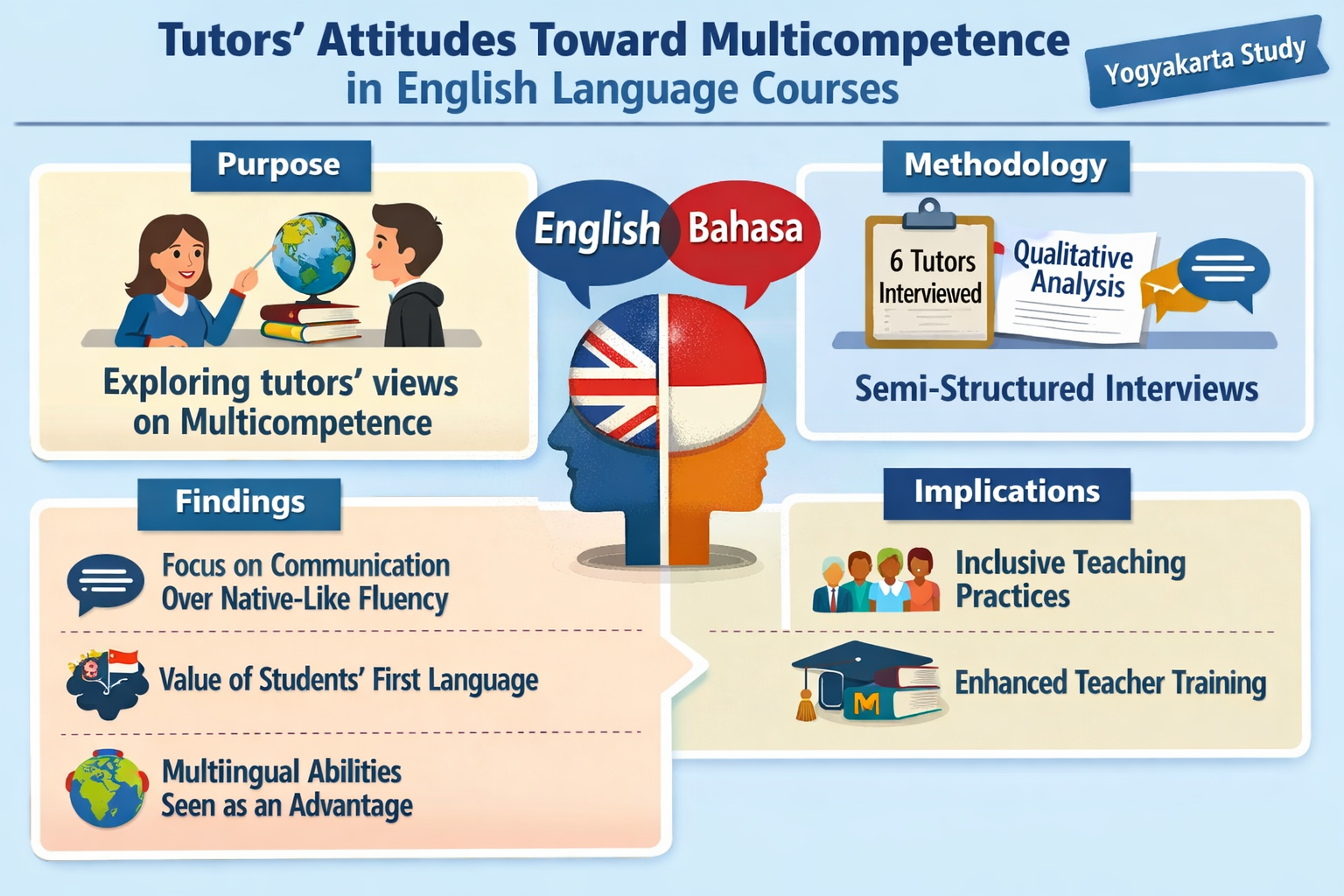
Purpose – This study investigates English tutors’ attitudes toward multicompetence in an English course in Yogyakarta. Multicompetence views language learners as users of multiple linguistic systems rather than imperfect native speakers. Despite its growing relevance in language education, limited research explores how tutors in private language courses perceive this concept. Therefore, this study aims to examine tutors’ perspectives on multicompetence and its relevance to English language learning.
Methodology – This study employed a qualitative descriptive research design. Six English tutors from an English course institution in Yogyakarta were selected using purposive sampling. Data were collected through semi-structured interviews to explore tutors’ perceptions of multicompetence. The analysis followed three stages: familiarization with the data, coding, and interpretation. The interview transcripts were analyzed thematically to identify patterns related to teaching perspectives and the use of learners’ first language.
Findings – Tutors generally hold positive attitudes toward multicompetence. They emphasize effective communication rather than native-like fluency and consider students’ first language as a valuable learning resource. Tutors also view multilingual ability as an advantage in language learning. The study suggests that integrating multicompetence into teaching can support communicative competence and more inclusive learning environments.
Novelty – This study provides insights into tutors’ perceptions of multicompetence within the context of private English language courses.
Significance – The findings may benefit English teachers, teacher trainers, language course providers, and researchers by helping develop more inclusive language-teaching practices.
Article Details

This work is licensed under a Creative Commons Attribution 4.0 International License.
References
Ajzen, I. (1991). The theory of planned behavior. Organizational Behavior and Human Decision Processes, 50(2), 179–211.
Ary, D., Jacobs, L. C., Sorensen, C., & Razavieh, A. (2014). Introduction to Research in Education (9th ed.). Wadsworth, Cengage Learning.
Borg, S. (2003). Teacher cognition in language teaching: A review of research on what language teachers think, know, believe, and do. Language Teaching, 36(2), 81–109.
Brown, A. (2023). Monolingual versus multilingual foreign language teaching: French and Arabic at beginning levels. Language Teaching Research, 27(6), 1634–1659. https://doi.org/10.1177/1362168821990347
Cook, V. (1991). The poverty-of-the-stimulus argument and multi-competence. Second Language Research, 7(2), 103–117.
Cook, V. (1991). The poverty-of-the-stimulus argument and multi-competence. Second Language Research, 7(2), 103–117.
Cook, V. (1992). Evidence for multicompetence. Language Learning, 42(4), 557–591.
Cook, V. (2007). Multi-competence: Black-hole or worm-hole for second language acquisition research? In Z. Han (Ed.), Understanding second language process (pp. 16–26). Multilingual Matters.
Cook, V. (2007). Multi-competence: Black-hole or worm-hole for second language acquisition research? In Z. Han (Ed.), Understanding second language process (pp. 16–26). Multilingual Matters.
Cook, V. (2012). Language teaching methodology and the L2 user perspective. Routledge.
Costa, M., Kangasjarvi, E., & Charise, A. (2020). Beyond empathy: a qualitative exploration of arts and humanities in pre-professional (baccalaureate) health education. Advances in Health Sciences Education, 25(5), 1203–1226. https://doi.org/10.1007/s10459-020-09964-z
Derwing, T. M., & Munro, M. J. (2021). The role of accent in English language teaching and learning. Language Teaching Research, 25(2), 144-160.
Fakhrudin, M. F., Suwandi, S., Turini, Willy Eka Septian, & Ramadhani, A. (2024). Modern Islamic Boarding School English Teachers’ Workload and Their Performance : A Phenomenological Analysis. Journal of Literature Language and Academic Studies, 3(02), 68–74. https://doi.org/10.56855/jllans.v3i02.1172
Friedman, D. A. (2023). Language socialization and academic discourse in English as a Foreign Language contexts: A research agenda. Language Teaching, 56(2), 261–275. https://doi.org/10.1017/S0261444821000422
García, O., & Wei, L. (2014). Translanguaging: Language, bilingualism and education. Palgrave Macmillan.
García, O., & Wei, L. (2023). Translanguaging: Language, Bilingualism and Education. Routledge.
García, O., & Wei, L. (2023). Translanguaging: Language, Bilingualism and Education. Routledge.
Gilbert, J. B. (2023). Clear speech: Pronunciation and listening comprehension in North American English. Cambridge University Press.
Gundarina, O., & Simpson, J. (2022). A monolingual approach in an English primary school: practices and implications. Language and Education, 36(6), 523–543. https://doi.org/10.1080/09500782.2021.1945084
Herdina, P., & Jessner, U. (2002). A dynamic model of multilingualism: Perspectives of change in psycholinguistics. Multilingual Matters.
Holliday, A. (2005). The struggle to teach English as an international language. Oxford University Press.
Holliday, A. (2005). The struggle to teach English as an international language. Oxford University Press.
Huang, J. (2022). The Role of Parents in Language Development: Insights from Recent Research. Language Teaching Research, 26(2), 185-202.
Jenkins, J. (2009). World Englishes: A resource book for students. Routledge.
Jenkins, J. (2022). Global Englishes: A resource for language teachers. Routledge.
Jessner, U. (2008). A DST model of multilingualism and the role of metalinguistic awareness. The Modern Language Journal, 92(2), 270–283.
Johnson, M. (2022).The Impact of Native-Like Norms on Language Learning. Journal of Language Education, 35(2), 124-139.
Johnson, R., & Lee, S. (2022).The Challenges of Multilingual Education: A Critical Review. Educational Research Review, 15(2), 142-158.
Kormos, J., & Csizér, K. (2022). The Impact of Attitudes Towards Linguistic Diversity on Pedagogical Choices in Language Education. Language Teaching Research, 26(1), 59-76.
Kubanyiova, M. (2006). Developing a motivational teaching practice in EFL teachers in Slovakia: Challenges of promoting teacher change in EFL contexts. TESL-EJ, 10(2), 1–17.
Kurniawan, A. (2024). Multilingualism and Social Cohesion in Indonesia: A Review of Recent Studies. Journal of Multicultural Education, 18(1), 45-60.
Kunschak, C. (2021). Translingual transcultural competence: student agency, teacher guidance, and program support. Language Learning in Higher Education, 11(2), 343–358. https://doi.org/10.1515/cercles-2021-2029
Lamb, M. (2012). A self system perspective on young adolescents’ motivation to learn English in urban and rural settings. Language Learning, 62(4), 997–1023.
Li, W. (2021). Multilingualism and Language Transfer: Cognitive and Educational Perspectives. John Benjamins Publishing Company.
Martínez, A., & Soto, P. (2023).Language Hierarchies and Multilingualism: Analyzing Classroom Dynamics. Language and Society, 32(1), 29-45.
Matsuda, A. (2021). Teaching English as an international language: A context-based approach. Oxford University Press.
Nguyen, G. T. T., & Nguyen, T. T. K. (2024). English-majored Students’ Perceptions of Their Autonomy in English Language Learning. International Journal of Contemporary Studies in Education (IJ-CSE), 3(2), 146–166. https://doi.org/10.56855/ijcse.v3i2.1078
O'Reilly, T., & Weninger, C. (2022).Standard Language Norms and Non-Native English Speakers. Language Assessment Quarterly, 19(1), 56-72.
Ortega, L. (2016). Multi-competence. In L. Ortega (Ed.), The encyclopedia of applied linguistics. Wiley.
Ortega, L. (2016). Multi-competence. In L. Ortega (Ed.), The encyclopedia of applied linguistics. Wiley.
Pavlenko, A. (2000). L2 influence on L1 in late bilingualism. Issues in Applied Linguistics, 11(2), 175–205.
Pavlenko, A. (2005). Emotions and multilingualism. Cambridge University Press.
Putri, E. A., & Zulfikar, A. (2023). Embracing linguistic diversity in Indonesian EFL classrooms. Asian EFL Journal, 28(4), 56-74.
Saito, K., & Plonsky, L. (2022). The effectiveness of pronunciation instruction in second language learning: A meta-analysis. TESOL Quarterly, 56(2), 480-507.
Sari, D. (2023). Fostering Inclusion through Multilingual Education: The Indonesian Context. Asian Journal of Language and Culture, 11(4), 56-73.
Smith, J., & Robinson, L. (2023). Interference Effects and Language Accuracy: A Study of Non-Native English Speakers. TESOL Quarterly, 57(3), 310-328.
Subekti, A. S. (2018). Multilingual identity constructions by Indonesian lecturers of English in relation to the notion of native speaker. Indonesian Journal of Applied Linguistics, 8(1), 148–156.
Subekti, A. S. (2018). Multilingual identity constructions by Indonesian lecturers of English in relation to the notion of native speaker. Indonesian Journal of Applied Linguistics, 8(1), 148–156.
Sugiyono. (2016). Metode Penelitian Pendidikan: Pendekatan Kuantitatif, Kualitatif dan R&D. Alfabeta.
Sutrisno, A., Wahyudi, I., & Santosa, H. (2022). Cultural tolerance and language education: Perspectives from Indonesian teachers. Journal of Language and Culture, 31(1), 95-110.
Tanaka, M., & Yamada, K. (2021). Cognitive and Emotional Implications of Multilingual Education. Journal of Educational Psychology, 27(4), 301-318.
Thompson, G., & Kecskes, I. (2021). The Challenges of First Language Influence in English Learning. Applied Linguistics Review, 12(4), 485-503.
Ting, H., & Irawan, A. (2021). Cultural pluralism and language learning in Indonesia: Challenges and opportunities. Indonesian Journal of Applied Linguistics, 11(3), 345-359.
Wibowo, A., & Kurniawati, R. (2021).Cultural Diversity and Language Education in Indonesia. Indonesian Journal of Applied Linguistics, 11(1), 77-92.
Zhou, Y., & Zhang, X. (2022).Language Transfer and Proficiency: The Interplay of L1 Influence and Learning Outcomes. International Journal of Bilingual Education and Bilingualism, 25(5), 687-703.