The Impact of GeoGebra-Assisted Instruction on Students' Performance in Geometric Construction: Exploring Teacher Beliefs and Classroom Practices
Article Sidebar
Main Article Content
Abstract
Purpose – This study examined the effect of GeoGebra on students’ performance in geometric construction, with emphasis on students’ perceptions and teachers’ beliefs and instructional practices in a Ghanaian senior high school context.
Methodology – Guided by Social Constructivist Theory, the Technology Acceptance Model, and Cognitive Load Theory, the study adopted a pragmatic paradigm using a convergent mixed-methods design. The research was conducted at Nkyeraa Senior High School in the Wenchi Municipality of Ghana. The sample comprised 71 Form 3 students selected into experimental and control groups and five mathematics teachers. Quantitative data were collected using pre-test and post-test achievement tests and a ten-item five-point Likert scale questionnaire on students’ perceptions. Independent samples t-tests were used for data analysis. Qualitative data were gathered through semi-structured interviews with teachers and analyzed using thematic analysis.
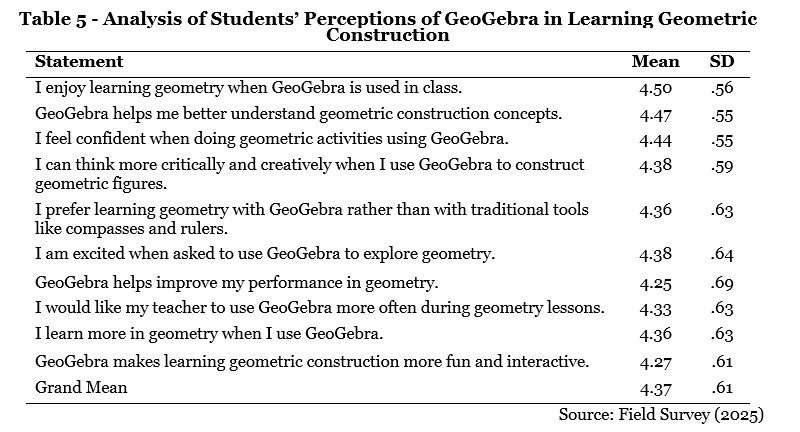
Findings – Pre-test results showed no significant difference between the experimental and control groups, indicating equivalence. Post-test results revealed that students taught using GeoGebra performed significantly better than those taught through traditional methods. Students demonstrated positive perceptions of GeoGebra-assisted learning, with a grand mean score of 4.37. Four themes emerged from teacher interviews: beliefs about GeoGebra, perceived impact on learning, instructional strategies, and challenges and support needs.
Novelty – The study integrates students’ achievement, perceptions, and teachers’ beliefs within a single mixed-method framework in a Ghanaian senior high school setting.
Significance – The findings benefit mathematics teachers, curriculum developers, and policymakers by supporting the integration of GeoGebra, teacher professional development, and improved ICT infrastructure in mathematics education.
Article Details
References
Adelabu, F. M., Marange, I. Y., & Alex, J. (2022). GeoGebra Software to Teach and Learn Circle Geometry: Academic Achievement of Grade 11 Students. Mathematics Teaching Research Journal, 14(3), 2-16.
Aidoo, B., Macdonald, A., Gyampoh, A. O., Baah, K. A., & Tsyawo, J. (2022). Factors influencing teachers' online teaching competence in higher education. Social Education Research, 148-160.
Akendita, P. A., Boateng, F. O., Arthur, Y. D., Banson, G. M., Abil, M., & Ahenkorah, M. (2025). The mediating role of teacher effective communication on the relationship between students’ mathematics interest and their mathematics performance. International Journal of Mathematics and Mathematics Education, 3(1), 1-17.https://doi.org/10.56855/ijmme.v3i1
Akendita, P. A., Obeng, B. A., Abil, M., & Ahenkorah, M. (2024). Investigating the effect of socio-constructivist mathematics teaching on students’ mathematics achievement: The mediating role of mathematics self-efficacy. Educational Point, 1(2), e110. https://doi.org/10.5678/epoint.2024.e110
Alabdulaziz, M. S., Aldossary, S. M., Alyahya, S. A., & Althubiti, H. M. (2021). The effectiveness of the GeoGebra Programme in the development of academic achievement and survival of the learning impact of the mathematics among secondary stage students. Education and Information Technologies, 26(3), 2685-2713. https://doi.org/10.1007/s10639-020-10371-5
Alebou, E. A., & Adu-Gyamfi, K. (2022). Effect of GeoGebra on senior high school students’ performance in circle theorems in Ghana. African Journal of Educational Studies in Mathematics and Sciences, 18(1), 85–99. https://doi.org/10.4314/ajesms.v18i1.7
Arbain, N., & Shukor, N. A. (2015). The effects of GeoGebra on students achievement. Procedia-Social and Behavioral Sciences, 172, 208-214.
Asare, J. T., & Atteh, E. (2022). The impact of using GeoGebra software in teaching and learning transformation (rigid motion) on senior high school students’ achievement. Asian Journal of Education and Social Studies, 33(1), 36–46. https://doi.org/10.9734/ajess/2022/v33i130784
Bakar, S. (2021). Investigating the dynamics of contemporary pedagogical approaches in higher education through innovations, challenges, and paradigm shifts. Social Science Chronicle, 1(1), 1-19.
Bang, T. C. (2024). Ensuring credibility and trustworthiness in qualitative inquiries. In applied linguistics and language education research methods: Fundamentals and innovations (pp. 70-85). IGI Global.
Bedada, T. B., & Machaba, M. (2022). Investigation of Student's Perception Learning Calculus with GeoGebra and Cycle Model. Eurasia Journal of Mathematics, Science and Technology Education, 18(10).
Bekene Bedada, T., & Machaba, M. F. (2022). The effect of GeoGebra on students’ abilities to study calculus. Education Research International, 2022(1), 4400024.
Birgin, O., & Topuz, F. (2021). Effect of the GeoGebra software-supported collaborative learning environment on seventh grade students’ geometry achievement, retention and attitudes. The Journal of Educational Research, 114(5), 474-494.
Black, P., & Wiliam, D. (2009). Developing the theory of formative assessment. Educational Assessment, Evaluation and Accountability, 21(1), 5–31. https://doi.org/10.1007/s11092-008-9068-5
Boaler, J. (2016). Mathematical mindsets: Unleashing students’ potential through creative math, inspiring messages and innovative teaching. Jossey-Bass.
Braun, V., & Clarke, V. (2006). Using thematic analysis in psychology. Qualitative research in psychology, 3(2), 77-101.
Cameron, M., & Lee, C. (2020). The impact of digital mathematics tools on student learning outcomes. Computers & Education, 152, 103873. https://doi.org/10.1016/j.compedu.2020.103873
Chandler, P., & Sweller, J. (1991). Cognitive load theory and the format of instruction. Cognition and Instruction, 8(4), 293–332. https://doi.org/10.1207/s1532690xci0804_2
Creswell, J. W., & Inoue, M. (2025). A process for conducting mixed methods data analysis. Journal of General and Family Medicine, 26(1), 4-11.
Daniels, H. (2001). Vygotsky and pedagogy. Routledge.
Davis, F. D. (1989). Perceived usefulness, perceived ease of use, and user acceptance of information technology. MIS Quarterly, 13(3), 319–340. https://doi.org/10.2307/249008
Davis, F. D., Bagozzi, R. P., & Warshaw, P. R. (1992). Extrinsic and intrinsic motivation to use computers in the workplace. Journal of Applied Social Psychology, 22(14), 1111–1132. https://doi.org/10.1111/j.1559-1816.1992.tb00945.x
Drijvers, P. (2015). Digital technology in mathematics education: Why it works (or doesn’t). In Selected regular lectures from the 12th international congress on mathematical education (pp. 135-151). Cham: Springer International Publishing.
Ertmer, P. A. (1999). Addressing first- and second-order barriers to change: Strategies for technology integration. Educational Technology Research and Development, 47(4), 47–61. https://doi.org/10.1007/BF02299597
Gbormittah, D. (2024). Preservice teachers’ attitude toward the use of technology in teaching and learning college geometry. Education and Information Technologies.
Hall, J. (2022). Technology in mathematics classrooms: Teachers’ beliefs and practices. International Journal of STEM Education, 9(1), 12–25. https://doi.org/10.1186/s40594-022-00351-1
Hampson, T., & McKinley, J. (2023). Problems posing as solutions: Criticising pragmatism as a paradigm for mixed research. Research in Education, 116(1), 124-138.
Hasmath, R., & Hameed, S. (2021). The role of ICT in advancing secondary school mathematics achievement. Journal of Educational Technology & Society, 24(3), 45–60.
Hennessy, S. (2010). Teacher factors influencing classroom use of ICT in Sub-Saharan Africa. Itupale Online Journal of African Studies.
Hollebrands, K., Conner, A., & Lee, H. S. (2018). Preparing teachers to use dynamic geometry software in teaching. Contemporary Issues in Technology and Teacher Education, 18(2), 230–254.
Hossan, D., Dato’Mansor, Z., & Jaharuddin, N. S. (2023). Research population and sampling in quantitative study. International Journal of Business and Technopreneurship (IJBT), 13(3), 209-222.
Huang, M. (2025). Student engagement and speaking performance in AI-assisted learning environments: A mixed-methods study from Chinese middle schools. Education and Information Technologies, 30(6), 7143–7165. https://doi.org/10.1007/s10639-024-12989-1
Izah, S. C., Sylva, L., & Hait, M. (2023). Cronbach's alpha: A cornerstone in ensuring reliability and validity in environmental health assessment. ES Energy & Environment, 23, 1057.
Jones, K. (2020). The role of visualization in mathematics learning. Mathematics Education Research Journal, 32(3), 353–369. https://doi.org/10.1007/s13394-019-00287-5
Jones, K., & Mooney, C. (2019). Teachers’ use of technology for mathematical reasoning. Research in Mathematics Education, 21(2), 153–169. https://doi.org/10.1080/14794802.2019.1602487
Kaur, R., & Manonmani, T. (2023). Integrating ICT in geometry: A study of secondary school classrooms. Journal of Mathematics Teacher Education, 26(4), 789–807. https://doi.org/10.1007/s10857-022-09570-3
Khan, N. (2024). Research Ethics in Education and Training. Ethical Frameworks in Special Education: A Guide for Researchers (Volume 2nd), 79.
Khansila, P., Yonwilad, W., Nongharnpituk, P., & Thienyutthakul, S. (2022). Improving Academic Performance in Geometry Using a Mastery Learning Approach through GeoGebra. Journal of Educational Issues, 8(2), 876-894.
Khormi, S. A. H. (2023). Integrating GeoGebra into a primary mathematics teaching intervention: impact on students’ learning processes and outcomes (Doctoral dissertation, Newcastle University).
Kilpatrick, J., Swafford, J., & Findell, B. (2001). Adding it up: Helping children learn mathematics. National Academy Press.
Koc, M., & Tatar, E. (2022). The effect of GeoGebra-assisted instruction on mathematics achievement. Education and Information Technologies, 27(6), 8171–8191. https://doi.org/10.1007/s10639-022-10902-7
Koehler, M. J., & Mishra, P. (2009). What is technological pedagogical content knowledge (TPACK)? Contemporary Issues in Technology and Teacher Education, 9(1), 60–70.
Kugblenu, K. A. F. U. I. (2022). Investigating the effect of geogebra learning tool on the acquisition of concepts in circle theorems by senior high school students in Anloga district (Doctoral dissertation, University of Education Winneba).
Li, Q., Ma, X., & Liu, Y. (2021). The effect of using GeoGebra in geometry teaching: Evidence from Chinese secondary schools. International Journal of Mathematical Education in Science and Technology, 52(7), 1069–1085. https://doi.org/10.1080/0020739X.2020.1717654
Lincoln, Y. S., & Guba, E. G. (1985). Naturalistic inquiry. Sage Publications.
Liu, M., & Chiu, T. K. F. (2021). Student engagement in ICT-based mathematics learning. Journal of Computer Assisted Learning, 37(4), 1220–1234. https://doi.org/10.1111/jcal.12553
Liu, X. (2025). Pedagogical adaptions of Chinese students on a UK Music Education MA programme: Perceptions of Chinese students, MA teaching staff, and Chinese returnees (Doctoral dissertation, University of York).
MacMahon, S., Leggett, J., & Carroll, A. (2022). Partnering to learn: A collaborative approach to research translation for educators and researchers. Mind, Brain, and Education, 16(2), 79-88.
Marange, I. Y., & Tatira, B. (2025). In-service mathematics teachers’ perceptions of GeoGebra integrative training materials: The case of geometry teaching. Eurasia Journal of Mathematics, Science and Technology Education, 21(2), em2588.
Mensah, J. (2023). Effectiveness of using geogebra in teaching and learning circle theorems on student-teachers’performance. European Journal of Education Studies, 10(11).
Mensah, P. A. A., Ansu, B., Karadaar, I. B., & Gurah, J. (2023). GeoGebra as a tool for improving mathematics instruction and learning by Ghanaian teachers. American Journal of Education and Technology, 2(2), 69–75. https://doi.org/10.54536/ajet.v2i2.1586
Meydan, C. H., & Akkaş, H. (2024). The role of triangulation in qualitative research: Converging perspectives. In Principles of conducting qualitative research in multicultural settings (pp. 98-129). IGI Global.
Mishra, P., & Koehler, M. J. (2006). Technological pedagogical content knowledge: A framework for teacher knowledge. Teachers College Record, 108(6), 1017–1054. https://doi.org/10.1111/j.1467-9620.2006.00684.x
Mokotjo, L., & Mokhele, M. L. (2021). Challenges of integrating GeoGebra in the teaching of mathematics in South African high schools.
Mosese, N., & Ogbonnaya, U. I. (2021). GeoGebra and Students' Learning Achievement in Trigonometric Functions Graphs Representations and Interpretations. Cypriot Journal of Educational Sciences, 16(2), 827-846.
NaCCA. (2019). Mathematics curriculum for senior high schools. Accra: National Council for Curriculum and Assessment.
NaCCA. (2020). Mathematics teaching syllabus. Accra: National Council for Curriculum and Assessment.
Narh-Kert, M., & Sabtiwu, R. (2022). Use of GeoGebra to improve performance in geometry. African Journal of Educational Studies in Mathematics and Sciences, 18(1), 29–36. https://doi.org/10.4314/ajesms.v18i1.3
Niess, M. L. (2005). Preparing teachers to teach science and mathematics with technology: Developing a technology pedagogical content knowledge. Teaching and Teacher Education, 21(5), 509–523. https://doi.org/10.1016/j.tate.2005.03.006
Nzaramyimana, E., Mukandayambaje, E., Iyamuremye, L., Hakizumuremyi, V., & Ukobizaba, F. (2021). Effectiveness of GeoGebra towards students’ active learning, performance and interest to learn mathematics. International Journal of Mathematics and Computer Research, 9(10), 2423-2430.
Owusu, R., Bonyah, E., & Arthur, Y. D. (2023). The effect of GeoGebra on university students’ understanding of polar coordinates. Cogent Education, 10(1), 2177050.
Polly, D., & Hannafin, M. (2011). Examining how learner-centered professional development influences teachers’ espoused and enacted practices. Educational Technology Research and Development, 59(6), 887–907. https://doi.org/10.1007/s11423-011-9201-0
Pretorius, L. (2024). Demystifying research paradigms: Navigating ontology, epistemology, and axiology in research. The Qualitative Report, 29(10), 2698-2715.
Prince, T. (2025). The impact of GeoGebra on student confidence and perceptions in Calculus III. International Journal of Mathematical Education in Science and Technology, 56(4), 634-645.
Shadaan, P., & Leong, K. E. (2013). Effectiveness of Using GeoGebra on Students' Understanding in Learning Circles. Malaysian Online Journal of Educational Technology, 1(4), 1-11.
Stylianides, A. J. (2008). An analytic framework of reasoning-and-proving. Educational Studies in Mathematics, 69(1), 23–47. https://doi.org/10.1007/s10649-007-9104-0
Sweller, J. (1988). Cognitive load during problem solving: Effects on learning. Cognitive Science, 12(2), 257–285. https://doi.org/10.1207/s15516709cog1202_4
Sweller, J. (1994). Cognitive load theory, learning difficulty, and instructional design. Learning and Instruction, 4(4), 295–312. https://doi.org/10.1016/0959-4752(94)90003-5
Tondeur, J., van Braak, J., Ertmer, P., & Ottenbreit-Leftwich, A. (2017). Understanding the relationship between teachers’ pedagogical beliefs and technology use in education: A systematic review. Educational Technology Research and Development, 65(3), 555–575. https://doi.org/10.1007/s11423-016-9481-2
Trouche, L. (2019). Evidencing missing resources of the documentational approach to didactics. Toward ten programs of research/development for enriching this approach. In The ‘resource’approach to mathematics education (pp. 447-489). Cham: Springer International Publishing.
Uwurukundo, M. S., Maniraho, J. F., & Tusiime, M. (2022). Enhancing students’ attitudes in learning 3-Dimension geometry using GeoGebra. International Journal of Learning, Teaching and Educational Research, 21(6), 286-303.
Vágová, R., & Kmetová, M. (2019). GeoGebra, a Tool to Improve Students' Visual Imaging. Acta Didactica Napocensia, 12(2), 225-237.
Venkatesh, V., & Davis, F. D. (2000). A theoretical extension of the technology acceptance model: Four longitudinal field studies. Management Science, 46(2), 186–204. https://doi.org/10.1287/mnsc.46.2.186.11926
Venkatesh, V., Morris, M. G., Davis, G. B., & Davis, F. D. (2003). User acceptance of information technology: Toward a unified view. MIS Quarterly, 27(3), 425–478. https://doi.org/10.2307/30036540
Voogt, J., Fisser, P., Good, J., Mishra, P., & Yadav, A. (2015). Computational thinking in compulsory education: Towards an agenda for research and practice. Education and Information Technologies, 20(4), 715–728. https://doi.org/10.1007/s10639-015-9412-6
Vygotsky, L. S. (1978). Mind in society: The development of higher psychological processes. Harvard University Press.
West African Examinations Council. (2023). Chief Examiners’ report on the West African Senior School Certificate Examination (WASSCE). Accra, Ghana: WAEC.
Wood, D., Bruner, J. S., & Ross, G. (1976). The role of tutoring in problem solving. Journal of Child Psychology and Psychiatry, 17(2), 89–100. https://doi.org/10.1111/j.1469-7610.1976.tb00381.x
Yohannes, A., & Chen, H. L. (2023). GeoGebra in mathematics education: a systematic review of journal articles published from 2010 to 2020. Interactive Learning Environments, 31(9), 5682-5697.
Zhang, Y., Xin, J. J., Yu, Z., Liu, Y., Zhao, W., Li, N., ... & Chen, G. (2025). Enhancing preservice teachers’ use of dialogic teaching and dynamic visualizations in mathematics classes: Bridging the knowing–doing gap. International Journal of Science and Mathematics Education, 1-31.
Zhou, Y., Zhou, Y., & Machtmes, K. (2024). Mixed methods integration strategies used in education: A systematic review. Methodological Innovations, 17(1), 41-49.