Contextualizing Collaborative Learning: A Comparative Study of Urban and Rural Senior High School Students’ Performance in Circle Theorems
Article Sidebar
Main Article Content
Abstract
Purpose – This study investigated whether school location moderates students’ achievement in Circle Theorems when instruction is delivered through collaborative learning in Ghanaian senior high schools. Although collaborative learning is frequently linked to improved mathematics achievement, evidence on its effectiveness across contrasting Ghanaian school contexts remains limited.
Methodology – Guided by Social Constructivist learning theory, the study employed a quantitative, quasi-experimental design. Two schools were purposively selected: one urban (School A) and one rural (School B). The sample comprised 152 students (n = 76 per school), with intact classes assigned as experimental and control groups. After the instructional intervention, data were collected using a 20-item multiple-choice Circle Theorems test. An independent-samples t-test was used to compare post-test performance of students taught via collaborative learning across the two locations.
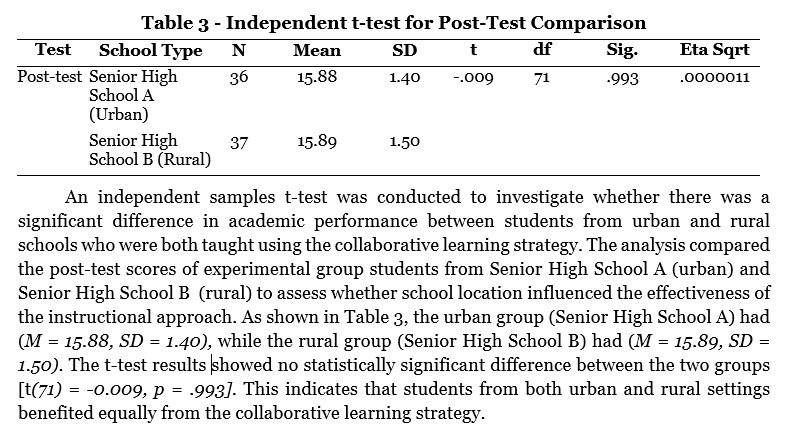
Findings – Results showed no statistically significant difference in Circle Theorems achievement between students in the rural and urban schools exposed to collaborative learning. This indicates that collaborative learning, when implemented effectively, produces comparable learning outcomes across settings, suggesting limited contextual influence. The findings support the scalability of collaborative learning as an equity-oriented instructional approach in geometry.
Novelty – The study contributes original, context-sensitive evidence by directly comparing the effects of collaborative learning on Circle Theorems achievement across rural and urban Ghanaian senior high schools, addressing a gap in local geometry education research.
Significance – Mathematics teachers, curriculum developers, and policymakers may use these findings to justify wider adoption of collaborative learning to strengthen conceptual understanding in geometry and promote equitable achievement across diverse school environments.
Article Details
References
Adeyinka, A. S., & Ogunbiyi, O. M. (2023). A Rural-Urban Comparison of the Effectiveness of Think-Pair-Share (TPS) Strategy of Instruction on Senior Secondary School Students’ Academic Achievement in Geography. CMU Academy Journal of Management and Business Education, 2(1), 25-34.
Adeyinka, A. S., & Ogunbiyi, O. M. (2023). A Rural-Urban Comparison of the Effectiveness of Think-Pair-Share (TPS) Strategy of Instruction on Senior Secondary School Students’ Academic Achievement in Geography. CMU Academy Journal of Management and Business Education, 2(1), 25–34. https://doi.org/10.54584/cajmbe.v2i1.65
Aidoo-Bervell, V. F. (2021). Assessing senior high school students thinking levels in solving problems on circle theorems the case of Mfantsiman Girls Senior High School.
Akendita, P. A., Obeng, B. A., Abil, M., & Ahenkorah, M. (2024). Investigating the effect of socio-constructivist mathematics teaching on students’ mathematics achievement: The mediating role of mathematics self-efficacy. Educational Point, 1(2), e110. https://doi.org/10.71176/edup/15662
Beigzadeh, A., Bazyar, H., Delzendeh, M., Razmi, M. H., & Sharifi, N. (2024). Comparing the effect of lecture method and cooperative teaching method on the learning, communication skills, and attitudes of students: a quasi-experimental study. In Frontiers in Education (Vol. 9, p. 1449538). Frontiers Media SA.
Chen, S., & Lee, S. W. (2024). Enhancing University Students' Soft Skills: A Quantitative Study on Problem-solving and Social Competence. Journal of Ecohumanism, 3(7), 4440-4454.
Cohen, J. (1988). Statistical power analysis for the behavioral sciences (2nd ed.). Lawrence Erlbaum Associates.
Dong, Y., Yin, H., Du, S., & Wang, A. (2021). The effects of flipped classroom characterized by situational and collaborative learning in a community nursing course: A quasi-experimental design. Nurse Education Today, 105, 105037.
Edwards-Fapohunda, M., & Adediji, M. (2024). The impact of the educational journey of special needs children on the employability, sociability, and economy of working-class parents in the UK. Iconic Research and Engineering Journals, 8(1), 421-436.
Engelbrecht, J., & Oates, G. (2022). Student collaboration in blending digital technology in the learning of mathematics. In Handbook of cognitive mathematics (pp. 1-39). Cham: Springer International Publishing.
Enoch, F. D. (2023). WAEC releases 2023 WASSCE results - Graphic Online. 721 https://www.graphic.com.gh/news/education/waec-releases-2023-wassce-results.html
Ghasemi, A., & Zahediasl, S. (2012). Normality tests for statistical analysis: a guide for non-statisticians. International journal of endocrinology and metabolism, 10(2), 486.
Han, F. (2021). The relations between teaching strategies, students’ engagement in learning, and teachers’ self-concept. Sustainability, 13(9), 5020.
Homuame, M. E. (2021). The content validity of teacher made core Mathematics tests in Senior High Schools (Doctoral dissertation, University of Education Winneba).
Khormi, S. A. H. (2023). Integrating GeoGebra into a primary mathematics teaching intervention: impact on students’ learning processes and outcomes (Doctoral dissertation, Newcastle University).
Kirschner, V., & Peltan, T. (2019). Towards better cooperative learning in urban planning education. Journal of Geography in Higher Education, 43(4), 399-414.
Lumley, T., Diehr, P., Emerson, S., & Chen, L. (2002). The importance of the normality assumption in large public health data sets. Annual review of public health, 23(1), 151-169.
Memon, F. N., & Memon, S. N. (2025). Digital divide and equity in education: Bridging gaps to ensure inclusive learning. In Impact of Digitalization on Education and Social Sustainability (pp. 107-130). IGI Global.
Mensah-Wonkyi, T., & Adu, E. (2016). Effect of the inquiry-based teaching approach on students’ understanding of circle theorems in plane geometry. African Journal of Educational Studies in Mathematics and Sciences, 12, 61-74.
Minarni, A., & Napitupulu, E. E. (2020). The role of constructivism-based learning in improving mathematical high order thinking skills of indonesian students. Journal of Mathematics Education (INFINITY), 9(1), 111-132.
NCTM, National Council of Teachers of Mathematics. (2020). Continuing the Journey: Principles to Actions; Principles and Standards for School Mathematics.
Nievecela, L. C., & Ortega-Auquilla, D. (2019). Using Cooperative Learning Strategies to Develop Rural Primary Students' English Oral Performance. English Language Teaching, 12(11), 74-84.
Ntow, F. D., & Hissan, Y. (2021). The impact of concept-based instruction on senior high school students’ achievement in circle theorems. African Journal of Educational Studies in Mathematics and Sciences, 17(1), 113–132. https://doi.org/10.4314/ajesms.v17i1.8
OECD. (2024). An Evolution of Mathematics Curriculum: Where It Was, Where It Stands and Where It Is Going. OECD Publishing.
Ole, F. C. B., & Gallos, M. R. (2021). Development and Validation of a Physics Concept Test in Kinematics for Senior High School Students. IOER International Multidisciplinary Research Journal, 3(2), 95-104.
Osakwe, R. N. (2019). Effect of collaborative learning on students’ academic achievement in junior secondary school business studies in Edo State, Nigeria. International Journal of Educational Research, 8(2), 134–145. Retrieved from https://www.ajol.info/index.php/ijer/article/view/186678
Saleem, A., Kausar, H., & Deeba, F. (2021). Social constructivism: A new paradigm in teaching and learning environment. Perennial journal of history, 2(2), 403-421.
Sarkar, P., Pillai, J. S., & Gupta, A. (2018, December). ScholAR: A collaborative learning experience for rural schools using augmented reality application. In 2018 IEEE Tenth International Conference on Technology for Education (T4E) (pp. 8-15). IEEE.
Sarwanti, S. (2018, July). Physical Environment of Rural School in Conducting Effective Collaborative Learning. In English Language and Literature International Conference (ELLiC) Proceedings (Vol. 2, pp. 309-312).
Sekhar, P. R., & Goud, S. (2024). Collaborative learning techniques in Python programming: A case study with CSE students at Anurag University. Journal of Engineering Education Transformations, 243-249.
Shrestha, D. K. (2022). COLLABORATIVE APPROACHES FOR TEACHING AND LEARNING GEOMETRY (Doctoral dissertation, Kathmandu University School of Education).
Sujatha, S., & Vinayakan, K. (2022). The Role of Collaborative Learning in Mathematics Education: A Review of Research and Practice. Indo American Journal of Multidisciplinary Research and Review, 6(2), 200-206.
Thamae, M. T. (2022). The teaching of Euclidean geometry: a universal design for learning approach.
Tolmie, A. K., Topping, K. J., Christie, D., Donaldson, C., Howe, C., Jessiman, E., ... & Thurston, A. (2010). Social effects of collaborative learning in primary schools. Learning and instruction, 20(3), 177-191.
UNESCO. (2021). Reimagining our futures together: A new social contract for education. UNESCO.
Vygotsky, L. S. (1978). Mind in society: The development of higher psychological processes. Harvard University Press.
Worley, P., Strasser, R., Prideaux, D., March, R., McKimm, J., & Marley, J. (2006). Vocational training of medical students in rural clinical settings: Comparison with metropolitan training. Medical Education, 40(2), 117–125. https://doi.org/10.1111/j.1365-2929.2005.02363.x
Zhao, Y., Zhao, M., & Shi, F. (2024). Integrating moral education and educational information technology: A strategic approach to enhance rural teacher training in universities. Journal of the Knowledge Economy, 15(3), 15053-15093.