Metacognitive Knowledge and Mathematics Engagement Among Senior High School Students: Mediating Role of Cognitive Flexibility
Article Sidebar
Main Article Content
Abstract
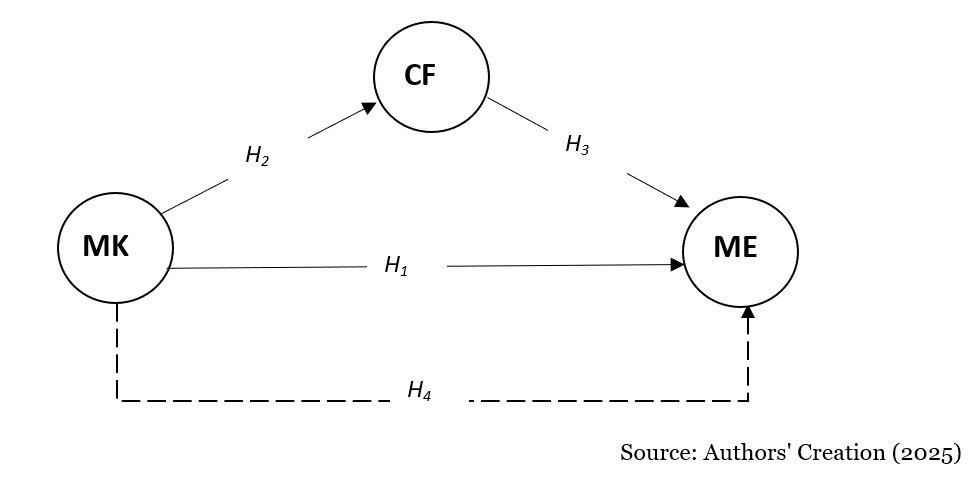
Purpose – The study aimed to investigate the impact of metacognitive knowledge on senior high school students’ engagement in mathematics and to explore cognitive flexibility as a mediating variable. The study addresses the ongoing disengagement in mathematics and the need to understand the cognitive processes that facilitate active learning.
Methodology – The study used a quantitative cross-sectional survey of 341 students from three senior high schools in Ghana. Participants were selected using both stratified and simple random sampling.
Findings – Metacognitive knowledge did not directly influence engagement in mathematics, but it did positively influence cognitive flexibility. Furthermore, cognitive flexibility positively affected engagement. Cognitive flexibility fully mediated the effect of metacognitive knowledge on mathematics engagement (β = 0.393, p < 0.001).
Novelty – This study provides a novel empirical contribution by demonstrating the full mediating role of cognitive flexibility in the relationship between metacognitive knowledge and mathematics learning engagement.
Significance – This study is helpful for teachers, curriculum developers, and educational researchers in designing mathematics learning strategies that emphasize the development of students' cognitive flexibility.
Significance – This study also contributes to the evidence from Ghana by demonstrating that engagement in mathematics depends on cognitive flexibility to supplement metacognitive knowledge, thereby providing valuable insight into the psychological mechanisms underlying mathematics learning.
Article Details
References
Akendita, P. A., Arthur, Y. D., & Asare, B. (2025). Moderating effect of teacher efficacy on the relationship between students' perception of mathematics and students' mathematics achievement. International Journal of Didactical Studies. 6(1), 1–17.
Aladini, A., Osman Abdul Wahab, M., Ismail, S. M., & Hashemifardnia, A. (2025). Ripples of reflection: how iterative reflective practices shape cognitive flexibility, emotional resilience, and problem-solving skills. Reflective Practice, 00(00), 1–19. https://doi.org/10.1080/14623943.2025.2596423
Arthur, Y. D., Vittori, T. De, Welcome, N. B., Dogbe, C. S. K., & Asare, B. (2024). Enhancing TVET students’ interest in mathematics through the history of mathematics and self-efficacy. In Journal of Applied Research in Higher Education. https://doi.org/10.1108/JARHE-05-2024-0238
Asare, B. (2026). Influence of ethnomathematics-based instruction on students’ attitudes, participation, and cultural connections in mathematics learning in Ghana. Cogent Education, 13(1). https://doi.org/10.1080/2331186X.2025.2612395
Asare, B., & Boateng, F. O. (2025). Self-awareness and self-regulatory learning as mediators between ChatGPT usage and pre-service mathematics teachers’ self-efficacy. Journal of Pedagogical Research.
Asare, B., Dissou Arthur, Y., & Adu Obeng, B. (2025). Mathematics self-belief and mathematical creativity of university students: the role of problem-solving skills. Cogent Education, 12(1). https://doi.org/10.1080/2331186X.2025.2456438
Asare, B., & Larbi, E. (2025). Nexus between emotional intelligence and mathematics performance : The role of metacognitive awareness. Cogent Education, 12(1). https://doi.org/10.1080/2331186X.2025.2450117
Bandura, A. (1999). Social cognitive theory: An agentic perspective. Asian Journal of Social Psychology, 2(1), 21–41. https://doi.org/10.1111/1467-839X.00024
Boateng, F. O., Bandoh, S. O., Kwarteng, S., & Lotey, E. K. (2024). Impact of Parent Interest in Mathematics and Students Mathematics Interest on Student Mathematics Achievement. Mathematics Education Journal, 8(2), 206–220. https://doi.org/10.22219/mej.v8i2.33182
Brinkhof, L. P., Ridderinkhof, K. R., Murre, J. M. J., Krugers, H. J., & de Wit, S. (2023). Improving goal striving and resilience in older adults through a personalized metacognitive self-help intervention: a protocol paper. BMC Psychology, 11(1), 1–23. https://doi.org/10.1186/s40359-023-01259-3
Caliskan, C., & Altun, M. (2025). The Impact of Cognitive Flexibility and Classroom Engagement on High School Students’ Creative Problem-Solving Skills. International Journal of Education in Mathematics, Science and Technology, 13(1), 61–75. https://doi.org/10.46328/ijemst.4466
Caspi, A., & Gorsky, P. (2024). STEM career expectations across four diverse countries: motivation to learn mathematics mediates the effects of gender and math classroom environments. International Journal of STEM Education, 11(Article 52). https://doi.org/10.1186/s40594-024-00511-5
Çetinkaya, A., & Haskan Avcı, Ö. (2025). The Serial Multiple Mediator Role of Emotion Regulation and School Resilience Between Cognitive Flexibility and School Engagement. Psychology in the Schools, 62(9), 3105–3118. https://doi.org/10.1002/pits.23526
Cotič, M., & Zuljan, M. V. (2009). Problem-based instruction in mathematics and its impact on the cognitive results of the students and on affective-motivational aspects. Educational Studies, 35(3), 297–310. https://doi.org/10.1080/03055690802648085
Creswell, J. W. (2014). Research design: Qualitative, quantitative, and mixed methods approaches (4th ed.). Sage Publications, 381–382. https://doi.org/10.7591/9781501721144-016
Davor, I., Boateng, F. O., & Lotey, E. K. (2024). The mediating role of metacognitive thinking in the relationship between attributional beliefs, academic buoyancy, error-management mindset, and mathematics achievement. European Journal of Mathematics and Science Education, 5(4), 213–225.
Dennis, J. P., & Vander Wal, J. S. (2010). The cognitive flexibility inventory: Instrument development and estimates of reliability and validity. Cognitive Therapy and Research, 34(3), 241–253. https://doi.org/10.1007/s10608-009-9276-4
Dogaru, M., Negreanu, M. C., Pisicǎ, O., & Pîrvu, A. F. (2025). STEM career: essential factors for students to achieve success in STEM (supportive individuals, skills/abilities, motivational factors). Frontiers in Education, 10. https://doi.org/10.3389/feduc.2025.1611178
Edo, H., & Asare, B. (2024). Pre-service teachers ’ mathematics achievement, attitude, and anxiety : The moderative role of pre-service teachers ’ interest in the learning process. Pedagogical Research 9(2).
El Galad, A., Betts, D. H., & Campbell, N. (2024). Flexible learning dimensions in higher education: aligning students’ and educators’ perspectives for more inclusive practices. Frontiers in Education, 9(April), 1–13. https://doi.org/10.3389/feduc.2024.1347432
Fornell, C., & Larcker, D. F. (2014). SEM with Unobservable Variables and Measurement Error. In Algebra and Statistics (Vol. 47, Issue 3, pp. 138-145).
Gaylo, D. N., & Dales, Z. I. (2017). Metacognitive Strategies: Their Effects on Students’ Academic Achievement and Engagement in Mathematics. World Review of Business Research, 7(2), 35–55. https://doi.org/10.5281/zenodo.3951851
Hair, J. F., Black, W. C., Babin, B. J., & Anderson, R. E. (2010). Multivariate data analysis: A global perspective (7th Ed). Pearson Education.
Haji-Othman, Y., & Yusuff, M. S. S. (2022). Assessing Reliability and Validity of Attitude Construct Using Partial Least Squares Structural Equation Modeling (PLS-SEM). International Journal of Academic Research in Business and Social Sciences, 12(5). https://doi.org/10.6007/ijarbss/v12-i5/13289
İdawati, İ., Setyosari, P., Kuswandi, D., & Ulfa, S. (2020). Investigating the effects of problem-solving methods and cognitive flexibility on improving university students’ metacognitive skills. Journal for the Education of Gifted Young Scientists, 8(2), 651–665. https://doi.org/10.17478/jegys.652212
Kalyuga, S., Renkl, A., & Paas, F. (2010). Facilitating flexible problem solving: A cognitive load perspective. Educational Psychology Review, 22(2), 175–186. https://doi.org/10.1007/s10648-010-9132-9
Katekhaye, D., & Magda, R. (2024). Corporate Practices: Policies, Methodologies, and Insights in Organizational Management. In Springer Proceedings in Business and Economics.
Leclercq, M., Gimenes, G., Maintenant, C., & Clerc, J. (2022). Goal choice in preschoolers is influenced by context, cognitive flexibility, and metacognition. Frontiers in Psychology, 13(February). https://doi.org/10.3389/fpsyg.2022.1063566
Lotey, E. K., Boateng, F. O., Arthur, Y. D., Adu-Obeng, B., & Gordon, J. F. (2025). Exploring GeoGebra acceptance: an implication for pre-service mathematics teachers’ professional development. Cogent Education, 12(1). https://doi.org/10.1080/2331186X.2025.2514980
Luttrell, V. R., Callen, B. W., Allen, C. S., Wood, M. D., Deeds, D. G., & Richard, D. C. S. (2010). The Mathematics Value Inventory for General Education Students: Development and Initial Validation. Educational and Psychological Measurement, 70(1), 142–160. https://doi.org/10.1177/0013164409344526
Marsh, H. W., Guo, J., Dicke, T., Parker, P. D., & Craven, R. G. (2020). Confirmatory Factor Analysis (CFA), Exploratory Structural Equation Modeling (ESEM), and Set-ESEM: Optimal Balance Between Goodness of Fit and Parsimony. Multivariate Behavioral Research, 55(1), 102–119. https://doi.org/10.1080/00273171.2019.1602503
Merkebu, J., Kitsantas, A., Durning, S. J., & Ma, Ti. (2023). What is metacognitive reflection? The moderating role of metacognition on emotional regulation and reflection. Frontiers in Education, 8(April), 1–14. https://doi.org/10.3389/feduc.2023.1166195
OECD (2023), PISA 2022 Results (Volume I): The State of Learning and Equity in Education, PISA, OECD Publishing, Paris, https://doi.org/10.1787/53f23881-en.
Önen, A. S., & Koçak, C. (2015). The Effect of Cognitive Flexibility on Higher School Students’ Study Strategies. Procedia - Social and Behavioral Sciences, 191(1987), 2346–2350. https://doi.org/10.1016/j.sbspro.2015.04.680
Ong, K. J., Chou, Y. C., Yang, D. Y., & Lin, C. C. (2020). Creative drama in science education: The effects on situational interest, career interest, and science-related attitudes of science majors and non-science majors. Eurasia Journal of Mathematics, Science and Technology Education, 16(4). https://doi.org/10.29333/ejmste/115296
Passolunghi, M. C., Caviola, S., De Agostini, R., Perin, C., & Mammarella, I. C. (2016). Mathematics anxiety, working memory, and mathematics performance in secondary-school children. Frontiers in Psychology, 7(FEB), 1–8. https://doi.org/10.3389/fpsyg.2016.00042
Roemer, E., Schuberth, F., & Henseler, J. (2021). HTMT2–an improved criterion for assessing discriminant validity in structural equation modeling. Industrial Management and Data Systems, 121(12), 2637–2650. https://doi.org/10.1108/IMDS-02-2021-0082
Sürücü, L., & Maslakçi, A. (2020). Validity and Reliability in Quantitative Research. Business & Management Studies: An International Journal, 8(3), 2694–2726. https://doi.org/10.15295/bmij.v8i3.1540
Taherdoost, H. (2018). Validity and reliability of the research instrument: How to test the validity of a questionnaire/survey in research. International Journal of Academic Research in Management, 5(3), 28–36. https://doi.org/10.2139/ssrn.3205040
Vovides, Y., Sanchez-Alonso, S., Mitropoulou, V., & Nickmans, G. (2007). The use of e-learning course management systems to support learning strategies and to improve self-regulated learning. Educational Research Review, 2(1), 64–74. https://doi.org/10.1016/j.edurev.2007.02.004
Wang, J., & Jou, M. (2023). The influence of mobile-learning flipped classrooms on the emotional learning and cognitive flexibility of students of different levels of learning achievement. Interactive Learning Environments, 31(3), 1309–1321. https://doi.org/10.1080/10494820.2020.1830806
Wolters, C. A. (2003). Regulation of Motivation: Evaluating an Underemphasized Aspect of Self-Regulated Learning. Educational Psychologist, 38(4), 189–205. https://doi.org/10.1207/S15326985EP3804_1