Error Patterns and Predictors in Solving Algebraic Word Problems: Evidence from Secondary School Students
DOI:
https://doi.org/10.56855/jrsme.v5i1.1916Keywords:
Comprehension error, Encoding Error, Reading Errors, Word Problems, Process error, Translation errorAbstract
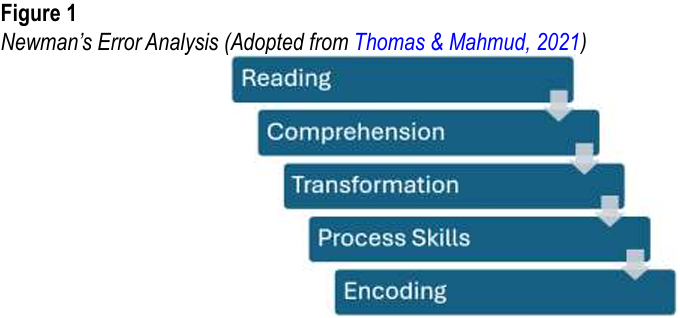
Purpose: Mathematics word problems, particularly in linear equations, remain challenging for secondary students due to difficulties in comprehension and algebraic reasoning. This study aims to analyze students’ errors in solving linear equation word problems using Newman’s Error Analysis, identify the underlying causes, and examine instructional practices that influence students’ performance. Methodology: A descriptive mixed-methods approach was employed, combining 220 students’ written responses to word problem tasks with 10 teacher interviews. Quantitative data were analyzed using descriptive statistics to determine the distribution of error types, while qualitative data were examined through thematic analysis to explore students’ difficulties and instructional factors. Findings: The findings indicate that errors occurred across all stages of Newman’s framework, with comprehension, transformation, and encoding errors being the most dominant, while reading errors were relatively minimal. Students experienced difficulties in interpreting problem contexts, translating verbal statements into algebraic expressions, and presenting accurate final answers. Significance: These errors were associated with misconceptions about variables and equality, limited conceptual understanding, and weak procedural fluency. In addition, instructional practices, including a strong emphasis on procedures and limited use of visual representations, contributed to these difficulties. This study highlights the importance of diagnostic error analysis and suggests the need for instructional approaches that integrate conceptual understanding, algebraic reasoning, and meaningful problem-solving experiences.
References
Abdullah, A. H., Abidin, N. L. Z., & Ali, M. (2015). Analysis of students’ errors in solving Higher Order Thinking Skills (HOTS) problems for the topic of fraction. Asian Social Science, 11(21), 133–142. https://doi.org/10.5539/ass.v11n21p133
Abdu, H., & Mbah, P. (2021). Errors in algebra problem solving among secondary school students. Journal of Mathematics Education, 14(2), 33–45.
Adu, E., Assuah, N., & Asiedu-Addo, S. (2015). Errors in solving linear equations in one variable: Evidence from Ghanaian secondary schools. International Journal of Education and Research, 3(8), 45–58.
Adu, E. (2013). Two problem-based learning approaches in mathematics education. Journal of Educational Research, 6(1), 24–36.
Adentude, A. I. (2007). Enhancing mathematics teaching and learning in second cycle institutions in Ghana. Pakistan Journal of Social Sciences, 4(3), 340–344.
Aghileri, F. (2001). Issues in teaching mathematical problem solving. Educational Studies in Mathematics, 46, 175–196.
Ahia, F., & Fredua-Kwarteng, E. (2012). Gazing Mathematics and Science education in Ghana. In SensePublishers eBooks (pp. 103–125). https://doi.org/10.1007/978-94-6091-702-8_8
Allan, P. (2005). Application of Newman’s error analysis in mathematics education. Mathematics Education Research Journal, 17(3), 23–36.
Allan, P. (2010). Extending Newman’s Error Analysis in secondary school mathematics. International Journal of Mathematics Education, 12(1), 45–57.
Anane, R., Jupri, A., & Alhassan, R. (2016). Students’ misconceptions in linear equations: Evidence from Ghana. Journal of Education and Practice, 7(5), 102–110.
Anghileri, J. (2001). Teaching number sense and calculation to primary children. Educational Studies in Mathematics, 46, 109–134.
Ashcraft, M. H., & Krause, J. A. (2020). Working memory, math anxiety, and performance: An integrative review. Current Directions in Psychological Science, 29(3), 240–246. https://doi.org/10.1177/0963721420910933
Ashlock, R. B. (2005). Error patterns in computation: Using error patterns to improve instruction. Pearson College.
Bardillion, A. (2004). Students’ use of prior knowledge in algebraic translation. Mathematics Education Research Journal, 16(2), 25–36.
Berger, M., & Bowie, L. (2020). Reading comprehension and its impact on mathematics problem-solving. Journal of Educational Research, 113(5), 347–356. https://doi.org/10.1080/00220671.2020.1712512
Blanton, M., Stephens, A., Knuth, E., Gardiner, A., Isler, I., & Kim, S. (2015). Building a coherent progression for algebra learning: The equal sign and variable understanding. Mathematics Teaching and Learning, 17(2), 1–21.
Blum, L., & Niss, M. (1991). Applied vs. pure mathematics problems. Educational Studies in Mathematics, 22(2), 147–163.
Black, P., & Wiliam, D. (2018). Classroom assessment and pedagogy. Assessment in Education: Principles, Policy & Practice, 25(6), 551–575. https://doi.org/10.1080/0969594X.2018.1461554
Blatchford, P., Bassett, P., Brown, P., & Martin, C. (2014). The impact of class size on pupils’ classroom engagement and teacher–pupil interaction: A systematic review. Learning and Instruction, 33, 1–15. https://doi.org/10.1016/j.learninstruc.2014.02.001
Boaler, J. (2016). Mathematical mindsets: Unleashing students' potential through creative math, inspiring messages and innovative teaching. Jossey-Bass/Wiley.
Boonen, T., Jolles, J., & Van der Schoot, M. (2016). Cognitive and metacognitive strategies in word problem solving. Learning and Instruction, 41, 1–10. https://doi.org/10.1016/j.learninstruc.2015.10.001
Brodie, K. (2013). Understanding learners’ errors in mathematics. Mathematics Education Research Journal, 25(1), 1–17.
Brodie, K. (2014). Learner errors and misconceptions in mathematics. Educational Studies in Mathematics, 86, 123–139.
Brodic, B., & Berger, A. (2010). Systematic and non-systematic errors in secondary mathematics. Journal of Educational Research, 103(2), 75–88.
Bruner, J. (2009). The process of education. Harvard University Press.
Cai, J., Wang, T., Moyer, J., & Nie, B. (2005). Students’ algebraic reasoning in linear equations. Educational Studies in Mathematics, 58, 27–49.
Casey, C. (1978). Applying Newman’s model in high school mathematics. Educational Studies in Mathematics, 10(1), 25–39.
Chusnul, A., Sudirman, S., & Nugroho, L. (2017). Applying Newman Error Analysis in junior high schools. International Journal of Education, 9(3), 78–85.
Clarkson, P. (1980). Mathematics errors in secondary school students. Journal of Educational Research, 73(5), 285–292.
Clarkson, P. (2014). Reading skills and mathematics comprehension: Implications for instruction. Mathematics Education Research Journal, 26(2), 135–153. https://doi.org/10.1007/s13394-013-0095-0
Clement, J. (2013). Misconceptions and errors in algebra learning. Journal for Research in Mathematics Education, 44(2), 1–21.
Cruz, C., & Lapinid, M. (2014). Word problem translation errors among secondary school students. Asian Journal of Education, 6(2), 45–59.
Cuevas, G. (2000). Problem-solving in mathematics. Mathematics Teaching, 172, 25–30.
Darling-Hammond, L., Hyler, M. E., & Gardner, M. (2017). Effective teacher professional development. Palo Alto, CA: Learning Policy Institute.
Dickson, L., Brown, M., & Gibson, O. (1994). Understanding errors in algebra: Newman’s stages applied. Mathematics Education Research Journal, 6(2), 12–26.
Dj Pomalato, S., Mahmud, A., & Zakaria, E. (2020). Errors in algebra: Applying Newman’s model. International Journal of Education and Practice, 8(4), 56–72.
Dweck, C. S. (2015). Growth. British Journal of Educational Psychology, 85(2), 242–245. https://doi.org/10.1111/bjep.12072
Effandi, Z., Ibrahim, M., & Siti, H. (2010). Applying Newman’s error analysis in secondary school algebra. Malaysian Journal of Mathematical Education, 3(1), 35–44.
Egodswatte, N. (2011). Errors and misconceptions in mathematics. Journal of Mathematical Behavior, 30, 1–12.
Etikan, I., & Bala, K. (2017). Sampling and population in research methodology. Biometrics & Biostatistics International Journal, 5(6), 00149.
Faradilla, F., Santoso, H., & Zakaria, E. (2019). Newman’s error analysis in quadratic problems. Journal of Mathematics Education, 10(1), 45–59.
Fuchs, L., Fuchs, D., & Prentice, K. (2012). Algebra learning and language proficiency. Journal of Learning Disabilities, 45(3), 203–216. https://doi.org/10.1177/0022219411428774
Gagné, R. M. (1985). The conditions of learning and theory of instruction (4th ed.). Holt, Rinehart & Winston.
Haqq, A., Prakash, P., & Singh, R. (2021). Newman error analysis in science education. Journal of Science Education, 22(2), 1–15.
Hassan, H., Mohammed, I., & Yeboah, S. (2016). Teaching mathematics in Ghana: Challenges and strategies. International Journal of Education Research, 5(3), 15–28.
Hattie, J., & Yates, G. (2014). Visible learning and the science of how we learn. Routledge.
Jha, S. (2012). Error analysis in mathematics education: A study using Newman’s model. International Journal of Mathematics Education, 4(2), 23–34.
Jupri, A., Drijvers, P., & van den Heuvel-Panhuizen, M. (2014b). Students’ misconceptions in algebra. Mathematics Education Research Journal, 26(1), 45–64.
Kantowski, M. (2002). Problem-solving in mathematics instruction. Mathematics Teacher, 95(7), 488–492.
Kieran, C. (2006). Learning and teaching algebra at the middle school level. Mathematics Education Research Journal, 18(2), 60–78.
Kieran, C. (2007). Transformations in algebra: Students’ difficulties. Educational Studies in Mathematics, 64, 123–138.
Khazanov, Y. (2008). Non-systematic errors in mathematical problem solving. Journal of Educational Research, 101(3), 145–152.
Kilpatrick, J. (1985). Problem solving in mathematics: Its nature and role. Mathematics Teacher, 78(3), 198–203.
Knuth, E., Alibali, M., McNeil, N., Weinberg, A., & Stephens, A. (2006). Middle school students’ understanding of the equal sign. Mathematical Thinking and Learning, 8(2), 1–27.
Koponen, I. (2019). Difficulties in learning algebra: A review. Journal of Mathematical Behavior, 53, 100–115.
Krantz, S. (2006). The elements of mathematics: From Euclid to Gödel. Cambridge University Press.
Leh, D., & Jitendra, A. (2013). Mathematics instruction and human development. Journal of Educational Development, 10(1), 45–60.
Lester, F., & Kehle, P. (2003). Problem solving in mathematics: Research perspectives. Mathematics Education Research Journal, 15(2), 1–15.
Lim, C. (2012). Common errors in problem-solving among Singaporean students. Asia-Pacific Education Review, 13(3), 465–476.
Linsell, C. (2008). Strategies for solving linear equations in one variable. Mathematics Education Research Journal, 20(3), 25–39.
Mahmud, A. (2003). Students’ difficulties in understanding word problems. Journal of Education and Practice, 4(5), 50–61.
Makonye, T., & Luneta, K. (2010). Systematic errors in algebra among secondary school learners. African Journal of Research in Mathematics, 14(2), 22–34.
McNeil, N., & Alibali, M. (2014). Understanding the equal sign: Symbolic representation in algebra learning. Journal of Mathematical Behavior, 33, 60–77. https://doi.org/10.1016/j.jmathb.2013.11.004
Mayer, R. (1985). Problem-solving in mathematics. Instructional Science, 14, 115–150.
Meyer, J., & Turner, J. (2011). Motivation and algebra learning. Educational Psychologist, 46(1), 1–18.
Mbewe, S. (2013). Mixed-methods research in education: Benefits and limitations. International Journal of Education, 5(4), 1–10.
Mugenda, O., & Mugenda, A. (2003). Research methods: Quantitative and qualitative approaches. African Centre for Technology Studies.
Moyer-Packenham, P., & Westenskow, A. (2013). Effects of virtual manipulatives on student achievement in mathematics: A meta-analysis. Educational Research Review, 9, 88–97. https://doi.org/10.1016/j.edurev.2012.12.002
National Council of Teachers of Mathematics (NCTM). (2000). Principles and standards for school mathematics. NCTM.
National Council of Teachers of Mathematics (NCTM). (2014). Principles to actions: Ensuring mathematical success for all. NCTM.
Newman, A. (1977). An analysis of sixth-grade pupils’ errors on written mathematical tasks. University of Newcastle.
Nesher, P. (1987). Conceptual errors and misconceptions in mathematics. Educational Studies in Mathematics, 18, 51–74.
Nguyen, L. (2017). Error analysis in linear equations: A review. Journal of Mathematics Education, 8(1), 45–58.
Ogolla, O. (2017). Students’ difficulties in algebra: Evidence from Kenya. Journal of Education and Practice, 8(3), 55–63.
Olivier, A. (1989). Learning mathematics: Misconceptions and conceptual development. Educational Studies in Mathematics, 20, 33–47.
OECD. (2021). Education at a glance 2021: OECD indicators. OECD Publishing. https://doi.org/10.1787/69096873-en
Pimm, D. (1987). Routledge Revivals: Speaking Mathematically (1987): Communication in Mathematics Clasrooms (1st ed.). Routledge. https://doi.org/10.4324/9781315278858
Polya, G. (2014). How to solve it: A new aspect of mathematical method (2nd ed.). Princeton University Press.
Pomellato, S., Mahmud, A., & Dj Pomalato, S. (2020). Newman error analysis in quadratic equations. International Journal of Education Research, 8(2), 77–91.
Prakitipong, N., & Nakamura, Y. (2006). Applying Newman error analysis in mathematics classrooms. International Journal of Mathematical Education, 7(2), 34–50.
Rahman, I. (2018). Student errors in mathematical word problems: A Newman Error Analysis approach. Journal of Mathematics Education, 9(2), 67–78.
Ramirez, R., Sales, M., & Tindowen, M. (2019). Translating word problems in mathematics learning. Journal of Mathematics Education, 12(1), 88–101.
Rauzah, R., Kusnandi, R., & Jupri, A. (2019). Newman error analysis of junior high school students. International Journal of Education, 11(3), 101–115.
Riccomini, P. (2008). Types of errors in mathematics learning. Learning Disabilities Research & Practice, 23(2), 90–102.
Roscoe, R., & Chi, M. (2014). Understanding tutor learning: Knowledge-building and knowledge-telling in peer tutoring. Instructional Science, 42, 1–25. https://doi.org/10.1007/s11251-013-9300-5
Ryan, J., & Williams, J. (2007). Children’s mathematics 4–15: Learning from errors and misconceptions. Sage.
Salleh, M. (2004). Problem-solving ability in mathematics. International Journal of Mathematical Education, 6(2), 34–50.
Salleh, M. (2018). Academic stress and student well-being. Journal of Education and Health, 10(1), 23–32.
Sainah, S. (1998). Difficulties in mathematics problem-solving among secondary students. Mathematics Education Review, 9(2), 15–28.
Santoso, H., Faradilla, F., & Zakaria, E. (2017). Newman error analysis in algebraic problems. Journal of Mathematics Education, 8(3), 22–35.
Schoenfeld, A. (1985). Mathematical problem solving. Academic Press.
Siegler, R. S., Duncan, G. J., Davis-Kean, P. E., Duckworth, K., Claessens, A., Engel, M., Susperreguy, M. I., & Chen, M. (2012). Early predictors of high school mathematics achievement. Psychological Science, 23(7), 691–697. https://doi.org/10.1177/0956797612440101
Singh, R., Haqq, A., & Prakash, P. (2010). Newman error analysis in secondary mathematics. International Journal of Education, 2(3), 56–68.
Star, J., Newton, K., & Garcia, R. (2015). Procedural knowledge and student errors in algebra. Journal of Mathematical Behavior, 39, 100–113. https://doi.org/10.1016/j.jmathb.2015.05.003
Suleiman, T., & Ismail, A. (2017). Comprehension errors in algebra word problems among secondary school students. International Journal of Education and Practice, 5(2), 55–65.
Thomas, A., & Mahmud, A. (2021). Newman error analysis framework: A review. Journal of Education Research, 14(1), 1–16.
Thompson, D.R., & Rubenstein, R.N. (2014). Literacy in Language and Mathematics. Journal of Adolescent & Adult Literacy, 58, 105-108.
Turner, R. (2011). Algebra learning and language proficiency. Mathematics Education Review, 23(2), 45–56.
Verschaffel, L., Greer, B., & De Corte, E. (2010). Whole number word problem solving. In K. R. Leatham (Ed.), Research in mathematics education (pp. 97–115). Routledge.
Vygotsky, L. S. (1978). Mind in Society: the development of higher psychological processes. In Medical Entomology and Zoology. https://ci.nii.ac.jp/ncid/BA03570814
Wanjala, P. (2016). Gender differences in algebra learning in Kenya. Journal of Mathematics Education, 7(1), 33–44.
Whitman, S. (1992). The formal strategy in algebra instruction. Mathematics Teacher, 85(4), 260–266.
Yadav, A. (2019). Mathematics education in Ghana: Challenges and opportunities. International Journal of Educational Development, 68, 12–23. https://doi.org/10.1016/j.ijedudev.2019.04.005
Downloads
Published
How to Cite
Issue
Section
License
Copyright (c) 2026 Emmanuel Gyimah Osei , Frederick Adu Gardiner, Johnson Dzotsi

This work is licensed under a Creative Commons Attribution 4.0 International License.