English
DOI:
https://doi.org/10.56855/jrsme.v4i1.1255Kata Kunci:
Compulsory Mathematics, Diverse Learners , Educational Programs , Social Constructivism, Namibia, Professional PathsAbstrak
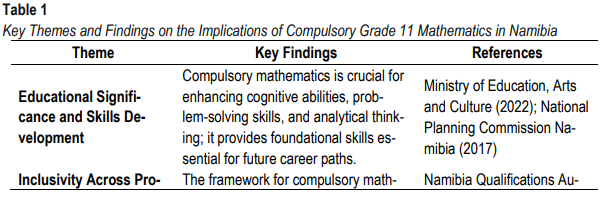
Purpose: This study investigates the implications of introducing compulsory Grade 11 Mathematics in Namibia, focusing on its impact on diverse learners and their future professional pathways. Methodology: Anchored in a social constructivist framework, the research examines how students perceive and engage with mathematics, acknowledging the cultural and contextual factors influencing learning experiences. Drawing on national education policies and international comparative studies, the study critically assesses the effectiveness of initiatives aimed at enhancing mathematics accessibility. Findings: Findings reveal significant challenges, including disparities in student aptitude and curriculum inflexibility, while also highlighting opportunities to foster mathematical literacy across a range of career fields. Significance: The research underscores the necessity of inclusive educational strategies that respond to the varied backgrounds, aspirations, and needs of Namibian learners. By offering empirical insights and a comprehensive literature analysis, the study contributes to the broader discourse on mathematics education reform and provides recommendations for policymakers and educators striving to align compulsory mathematics education with the diverse trajectories of Namibian students.
Referensi
Amukugo, H., & Kanyimba, A. (2004). Mathematics education in Namibia: Contextualizing the challenges.
Anderson, R. E., & Dexter, S. (2005). School technology leadership: An empirical investigation of the relationships between technology, leadership, and student outcomes.
Artigue, M. (2002). Didactical design in mathematics education. Educational Studies in Mathematics, 50(1), 27-30. https://doi.org/10.1023/A:1016100600937
Ashipala, J., & Nampila, N. (2006). Comparative analysis: International perspectives on mathematics education policies.
Bokhove, C., & Drijvers, P. (2012). The role of technology in mathematics education: Designing a research agenda. Research in Mathematics Education, 14(1), 14-34. https://doi.org/10.1080/14794802.2012.672491
Borba, M. C., & Villarreal, M. E. (2005). Educational technology, modelling, and change: The case of mathematics education. [Publisher/Source if applicable].
Freiman, V., & Gutbezahl, J. (2004). What do teachers need to teach mathematics with technology? In Proceedings of the In-ternational Conference on the Teaching of Mathematics. .
Goodchild, S., & Sutman, F. (2013). The impact of technological pedagogical content knowledge on student performance in mathematics. Journal of Technology and Teacher Education, 21(1), 1-18.
Godse, J. S. (2023). A Comprehensive review of contemporary developments in research concerning mathematics educa-tion. International Journal of Scientific Research in Science and Technology, 10(13), 221-226.
Hinda, S., & Kapenda, H. (2009). Teacher voices: Mathematics education challenges in Namibia. Namibia Educational Journal, 25(2), 1-12.
Hughes, J. S., Cummings, A., & O'Leary, S. (2006). A Review of Digital Resources: Effectiveness in the Classroom.
Human Sciences Research Council (HSRC). (2015). Mathematics education in Namibia: Challenges and opportunities.
NAMCOL. (2016). Improving access and inclusivity in mathematics education: A report.
Namibia Qualifications Authority (NQA). (2018). Bridging the gap: Mathematics skills for all professions.
Namibia Statistics Agency (NSA). (2008). Statistical trends: Mathematics literacy in Namibian schools.
Namibian Institute of Public Administration and Management (NIPAM). (2005). Capacity building: Mathematics teacher training manual.
National Planning Commission Namibia. (2017). Vision 2030: The role of mathematics education in national development.
National Policy on Mathematics Education. (2022). Ministry of Education, Arts and Culture, Namibia.
Niess, M. L., Guernsey, M., & Jansen, B. (2009). Preparing teachers to teach mathematics with technology.
RIME. (2020). Research Institute for Mathematics Education: Trends and challenges in Namibia.
Tondeur, J., au Vleuten, A., & van Braak, J. (2012). The integration of ICT in schools: An international perspective. International Journal of Educational Research, 1(4), 316-324. https://doi.org/10.1016/j.ijer.2011.09.001
UNESCO. (2014). Teaching and learning: Achieving quality for all.
Vygotsky, L. S. (1978). Mind in society: The development of higher psychological processes. Harvard University Press.
Unduhan
Diterbitkan
Cara Mengutip
Terbitan
Bagian
Lisensi
Hak Cipta (c) 2025 Moses Chirimbana, Hesekiel Kaukolwa Iilonga, Ferdinand Nghikepunye Kamati

Artikel ini berlisensi Creative Commons Attribution 4.0 International License.